The Ethnologisches Museum, Berlin.

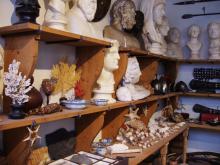
The Ethnological Museum in Berlin, is one of the largest ethnological museums in the world. At the moment it is housed on the University campus, out past the Botanical Gardens but will move to Schlossplatz in the center of Berlin in the near future.  There are plans to ‘reorganise and introduce new concepts to the presentation of the museum’s holdings’.  This is always a worry and I am interested to see how this is handled.  Apparently the museum ‘evolved from the collections of the royal cabinets of art’ and probably contains elements gleaned from cabinets of curiosity and reclassified.

We spent a whole day (spring 2014) engrossed by this incredible collection.

The Falstad Centre, Levanger, Norway

The Falstad Centre is the Norwegian Memorial and Human Rights Centre housing a large collection of photographs and artifacts from WWII and the initial period after the liberation.

I was there for a week (June 2013) with the REcall project, living in the refurbished former concentration camp. We were working with teams of young professional artists, architects and archeologists, questioning the conventions of the ‘memorial’ in relation to landscapes of terror.  This was a very poignant experience, visiting sites of murder, secret burial and the commandant’s house as well as the center’s museum.  With so much to digest it was perhaps not surprising that I was the only one interested in seeing the archives.  This however was the most moving and privileged experience, gently unwrapping objects produced by the prisoners of war; cigarette holders made from old toothbrushes, tin tobacco boxes engraved with the names of loved ones. Most moving of all,  a handkerchief stitched with found threads by one of the female prisoners.  Made as a Christmas present for her young son it shows her and her husband returning home.

Altötting, Bavaria, Germany.

Another personal fascination is for religious, particularly catholic ephemera and kitsch.  I have been visiting cathedrals, shines, collections and museums across the world for over 30 years and have built a collection of statues, prints, paintings and votives.

In the pursuit of extending my experience and collection a friend took me to the small town of Altötting, about 80 minutes east of Munich, the scene of religious pilgrimages by Catholics for over 500 years. Over one million pilgrims and visitors each year go to see the “Black Madonna” kept in the octagonal Chapel of Grace.

For me, the most fascinating aspect of the shrine is the hundreds of ex-voto paintings coating every inch of the exterior of the chapel.  They span hundreds of years, including one depicting an iron lung and several from WWII.

Altötting also has the ‘Jerusalem Panorama Crucifixion of Christ’. Housed in an unassuming, white, circular building is a monumental installation, a huge cylindrically shaped painting comprising 1,200 square meters. Constructed in 1902/3 by history painter Gebhard Fugel (1863-1939).  You view the painted scene from a central platform and the illusion is accentuated by full size scenery placed in the foreground.  You can view the construction by going below the platform and seeing the original rough wooden framework and plaster and scrim rocks etc.  Also intriguing is the construction of the roof; a circular canopy limits the light in the center of the space but allows natural light to fall on the painting.  This is the only light and therefore the weather and time of day outside, directly effects the atmosphere of the installation.

And if all this was not enough there is also the Mechanical Crib featuring 130 tiny automated figures, created in 1926-28. Housed in a small house down a side street, it depicts the story of Christ’s birth and other scenes from Bethlehem. 

Tropenmuseum, Amsterdam

Tropenmuseum, Amsterdam is a beautiful ethnographic museum, opened to the public in 1871.  One of the largest museums in Amsterdam, it has an extensive collection.  When I visited in 2012 it had a wonderful exhibition based on the colour RED in the central hall.  The permanent collections are a combination of original antique cabinets and innovative, eclectic assemblages, including some of my favorite types of display- scale models and full scale reconstructions. These include a small collection of cabinets with life-size, 3D portraits of famous Dutch explorers.  Each is set within a scenario, appropriate to the country and subject of exploration. These disturbingly resemble nothing as much as human taxidermy specimens.

Rembrandt House

Rembrandt House, Amsterdam, visited in 2012 has a wonderful collection of etchings but most notable for me was the reconstructed cabinet of curiosities. Apparently Rembrandt built up his own collection – not that you would know from the museum website.  It is interesting although a little underwhelming as it is over tidy and behind a low glass wall. 

Rembrandt's cabinet

Research Blog

museum

Rembrandt House

Rembrandt House, Amsterdam, visited in 2012 has a wonderful collection of etchings but most notable for me was the reconstructed cabinet of curiosities.

Rembrandt's cabinet

Fondaco dei Turchi, Venice

Venice, September 2012 while working on REcall, a major EU funded research project, led by Gennaro Postiglione, Politecnico di Milano, I visited the Fondaco dei Turchi.  One of the oldest buildings of Venice, it has

Museum für Naturkunde, Berlin

I first went to the Natural History Museum in Berlin in 2011.  The museum is a beautifully maintained 1889 purpose built building.  Damaged by bombing in WW2, the east wing was rebuilt in and contains wh

Collecting Museums

I will be using this blog to archive and share my research, thoughts and ideas that fuel my practice as an artist.  If you have any comments, thoughts or information you would like to share then please feel free to contact me.

La Venerina

Fondaco dei Turchi, Venice

Venice, September 2012 while working on REcall, a major EU funded research project, led by Gennaro Postiglione, Politecnico di Milano, I visited the Fondaco dei Turchi.  One of the oldest buildings of Venice, it has housed Venice’s Natural History museum since 1924.  Not expecting much, as I had read a few lack-lustre reviews, my pessimism was initially vindicated.  The museum seemed to be a hymn to MDF, Perspex and enormous digital prints.  Most of the room is taken up by massive displays; the ubiquitous ‘digital interactive interface’, video projection and the occasional ‘real’ object isolated in a glowing plastic vitrine.  However, as you continue into the heart of the museum you find several rooms that have been spared ‘modernisation’. These include the reconstruction of a small cabinet of curiosities with conjoined twin calves and a mermaid and an original scientific collection of small stuffed birds, fish and model viscera. The museum has had the sensitivity to preserve some elements of its own history and the history of scientific display.

Museum für Naturkunde, Berlin

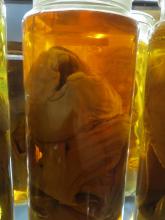
I first went to the Natural History Museum in Berlin in 2011.  The museum is a beautifully maintained 1889 purpose built building.  Damaged by bombing in WW2, the east wing was rebuilt in and contains what must be one of the most impressive wet specimen displays in the world.   This magnificent golden glass room is a cross between an opulent shrine and an extremely well funded art installation.  There is a strong, almost reverent atmosphere in the room as visitors whisper and slowly circumambulate the collection.

This kind of ambitious and innovative approach to museum display is extremely courageous.  It demonstrates a superb understanding of audience engagement while meeting all the latest standards in conservation and fire safety.  The design of both the room and the display are sensitive to the style of the rest of the museum that is also worth visiting.

There is not a single digital printout or explanatory text within the room and only discreet labeling at the entrance.

Collecting Museums

I will be using this blog to archive and share my research, thoughts and ideas that fuel my practice as an artist.  If you have any comments, thoughts or information you would like to share then please feel free to contact me.

For several years I have been surveying science museums in every city I visit, building a resource of experience, information and images.  I am particularly interested in historical displays; cabinets of curiosities, dated taxonomies and eclectic collections.  An element of this preoccupation is a critique of new museum display and a concern for the preservation of the history of the museums themselves.  Some science museums handle the integration of new displays and new conservation measures in a creative and sensitive way.  They are able to balance a responsibility for preserving the past with a concern for the future.  Other museums show little such care or respect.

This interest began with my photographic residency in the Great North Museum: Hancock.  Having access behind the scenes of the refurbishment was a unique experience at the time but this was not a ‘sensitive’ project.  Hardly anything of the original, beautiful Victorian interior has survived.  All the original cabinets were destroyed or sold, replaced by large, grey steel and heavy glass vitrines. The enormous wall of taxidermy that hits you as soon as you walk in is impressive but most of the presentation of the animals in the vitrines is stiff and over designed. 

But enough of this- let me start with a more positive example – the Palazzo Poggi in Bologna.  Please follow the link for all the information you will need.  I visited the museum in January 2012 in a snowstorm.  Although only restored in 2000 the cabinets have, been carefully constructed to look germane to the age of the objects within them.  It has a wonderful catalogue too – Walter Tega, Guide to the Museo di Palazzo Poggi: Science and Art, Editrice Compositori.   ISBN 978-88-7794-608-9

Other reading in relation to this topic:

Stephen T. Asma, 2001, Stuffed Animals and Pickled Heads, Oxford University Press.
Lawrence Weschler, 1995, Mr. Wilson’s Cabinet of Wonder, Vintage Books.

La Venerina