Museum of Pharmacy, Krakow


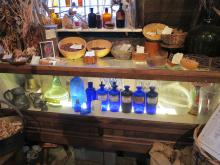
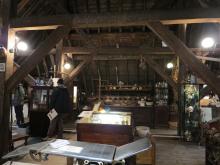
I first visited the Museum of Pharmacy Jagiellonian University Collegium Medicum in Krakow in January 2014.  Thinking it was going to be a small museum I only gave myself an hour in between meetings and it was only just enough time.  When we first entered we were directed, via a wonderful alchemists workshop, into the 15th century cellar that was packed with authentic early alchemical equipment and instruments.  Thinking this was the museum we took our time and were thoroughly engaged.  However on emerging from the basement we were directed to the other 4 floors of displays from medieval times to the WWII and the story of how a chemist shop that was once housed in the building, secretly provided help to the Jewish community.  It is absolutely packed full of majolica and glass jars that used to contain ingredients – including the rags off an Egyptian mummy and human fat.  A wonderful array of laboratory equipment, medicinal ingredients and memorabilia and curios connected with the history of health care.  Apparently they also have a library containing herbariums, pharmacopoeia and antidotaria -,a collection of antidotes against the plague.

There were a few (very poor) contemporary paintings dotted throughout the building by a local artist which seemed to imply that they might be open to the idea of working with an artist. I would love to come back one day and see if it were possible to conduct further research with their help and guidance and make some temporary pieces for display amongst their collection.

Grand Musee Spitzner

At the end of the tour of the Museum of Anatomy in the Faculty of Medicine in Montpellier we were taken to a separate room to see a new exhibition recently relocated from the Faculty of Medicine in Paris. It contained anatomical models that were once part of Pierre Spitzner’s traveling museum, the “Grand Musee Spitzner”, a famous set of anatomical wax models dating from the 19th Century.

This collection of models, casts, specimens, paintings, dioramas, etc. toured Europe for about a century before being dismantled around 1913. Some of the Spitzner pieces ended up at the University of Paris, but unfortunately many others have been lost. Spitzner’s centrepiece, a wax anatomical model of a sleeping woman, which opens to reveal her internal organs has survived however, as has several other striking obstetrical Venuses with strange disembodied male hands holding them down and preforming proceedures. Also a sleeping beauty whose chest would rise and fall as she seemed deep asleep, posing provocatively in her nightgown upon an uncomfortable looking rock.

The collection is of particular interest to my resent research and has a direct correlation to my Gallery of Wonder on Tour project, a mobile exhibition of extraordinary works of art, touring the agricultural fairs and border shepherd shows of Northumberland, UK, in a large black tent during summer 2015.  This project has its roots in the history that links cabinets of curiosity, traveling fairground exhibitions, public museums and science, therefor the touring museum of ‘le docteur Pierre Spitzner’ is of particular relevance to my continuing research.

Link to a very interesting essay Venus and the Archive –Waxworks of the Pregnant Body by Elizabeth Stephens

Museum of Anatomy of the Faculty of Medicine in Montpellier (France)

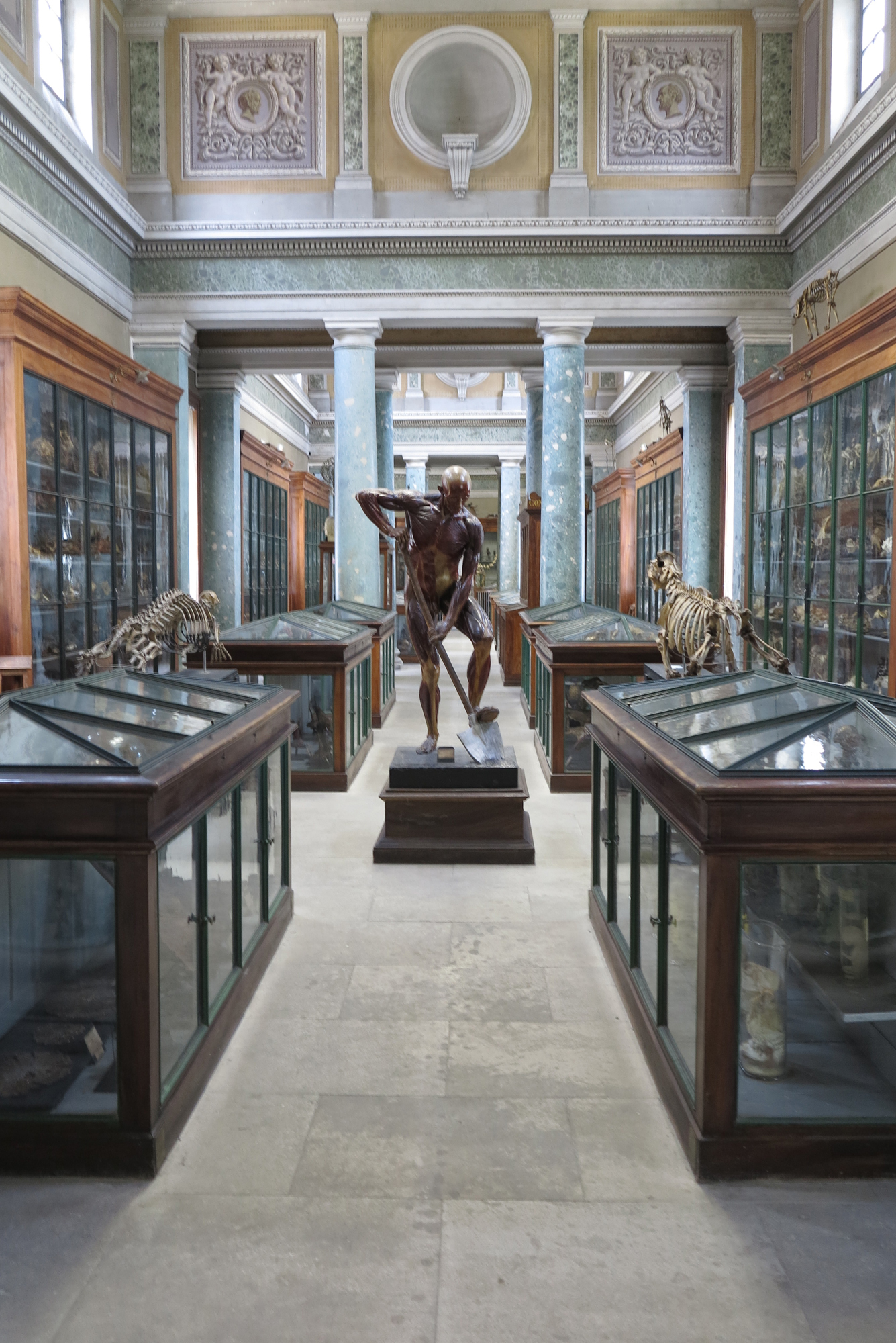
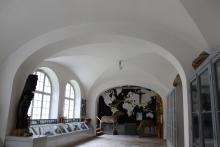
I have recently returned from a whistle stop tour of the museums and collections held by the University of Montpelier with a view to developing an exhibition in the Faculty of Medicine in 2016, responding to their incredible collection. The Faculty of Medicine has been operating since 1181 and their Museum of Anatomy is a rare and magnificent wonder.  One vast 60 meter long strikingly decorated gallery houses one of the largest and oldest anatomy collections in the world. The collection is exceptionally authentic and seems unchanged since its original construction in 1851. Hand written, labels in copperplate French and Latin describe the meticulous wax models of disease and deformity and carefully prepared human and animal specimens. The collection was cleaned and some repairs to the leaking roof made in 2004 but this was obviously carried out with a light touch, respecting not only the objects but also the heritage of the museum itself.  No doubt one or two of the anthropological and anatomical displays are problematic to contemporary eyes but it is, I believe important to have some record, some understanding of the development of both our scientific, ethical and moral progress.
We also visited the enigmatic Jardins des Plantes de l’Université Herbarium founded in 1593 with over 4,000,000 specimens. A vast catacomb of 1600-square-metres of dark shelf-lined corridors containing bulging portfolios of carefully pressed, preserved and catalogued plants and fungi and ancient herbal texts. We were also allowed access to the eclectic scientific collections temporarily housed in the attics and basement, awaiting a permanent home.

Old Operating Theatre Museum, London

A wonderful hidden gem is the Old Operating Theatre Museum and Herb Garret at the top of the church tower of St. Thomas near Borough Market in London (rebuilt 1703).  It seems an odd place to find an operating theatre but the south wing of St. Thomas’ hospital was originally built around the church.

You step off the street and into a narrow, steep spiral staircase.  This is the only access to the museum and adds to the sense of secrecy. 

The ‘Herb Garret ‘ refers to the Apothecary store that was originally established in the large roof space.  The museum is an eclectic mixture of objects ranging across areas and eras.  It is cross between a cabinet of curiosities, a medieval apothecary, an anatomical and surgical museum and cabinets full of miscellaneous loosely associated objects.

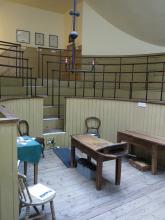
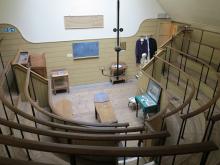
The operating theatre is the oldest in Europe.  Its unusual placement at the top of the church separated the theatre from the hospital wards.  Its presentation is beautifully simple, with little labeling and no information panels to disturb the distinctive still atmosphere of this unique space. 

Old Operating Theatre Museum
Herb Garret
Herb Garret

Research Blog

museum

Old Operating Theatre Museum, London

A wonderful hidden gem is the Old Operating Theatre Museum and Herb Garret at the top of the church tower of St.

Old Operating Theatre Museum

Natural History Museum, London

I had a couple of hours to kill in London recently so I thought I would visit the Natural History Museum for the first time in about 15 years.  I’m not sure if everything conspired against me but it was not a good experience.  After pa

Creepy Crawly Display

The Magic Circle Museum, London.

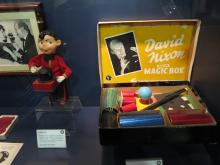
My resent research has focused on exploring connections between electricity, the supernatural and magic.

Missions Museum der Erzabtei St. Ottilien, Oberbayern, Germany.

This is a relatively small museum in the heart of a working monastery 40 km west of Munich. It houses zoological and ethnological artifacts brought back by the brothers from their missionaries in Africa and Asia.

Natural History Museum, Berlin

Easter 2014 I revisited the Natural History Museum in Berlin and it is clear that they are continuing to ‘re-shape the concept of a modern research museum’.  Their website actually states that this work will focus on the ‘sympathetic restoration and modernisation of collection rooms’ and from wha

Berlin Museum

ME Collectors Room, Berlin

The ME Collectors Room in Berlin (May 2014), next door to the KW Institute for Contemporary Art, houses the marvelous Wunderkammer Olbricht.

The Ethnologisches Museum, Berlin.

The Ethnological Museum in Berlin, is one of the largest ethnological museums in the world.

The Falstad Centre, Levanger, Norway

The Falstad Centre is the Norwegian Memorial and Human Rights Centre housing a large collection of photographs and artifacts from WWII and the initial period after the liberation.

Altötting, Bavaria, Germany.

Another personal fascination is for religious, particularly catholic ephemera and kitsch.  I have been visiting cathedrals, shines, collections and museums across the world for over 30 years and have built a collection of statues, prints, paintings and votives.

Tropenmuseum, Amsterdam

Tropenmuseum, Amsterdam is a beautiful ethnographic museum, opened to the public in 1871.  One of the largest museums in Amsterdam, it has an extensive collection.  When I visited in 2012 it had a wonderful exhibition ba
Natural History Museum, London

I had a couple of hours to kill in London recently so I thought I would visit the Natural History Museum for the first time in about 15 years.  I’m not sure if everything conspired against me but it was not a good experience.  After paying £6 to put my tiny suitcase in left luggage I headed out optimistically to revisit old favourites and see the recent additions. 

I found the new Cocoon research center impressive architecturally but the displays very disappointing.  Maybe you need to be under the age of 11 to appreciate them but I found them over reliant on large format digital printouts, Perspex boxes and concrete.  There is the occasional cabinet with a display of insects, and glimpses of intriguing science happening in the interior of the building but the endless grey corridor is just irritating.

The ‘Spirit Collection’, containing the wet specimens in jars of alcohol was closed, apparently without warning for an impromptu meeting, and the dinosaur room was being cleaned!

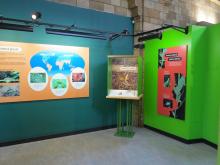
Of course there are still areas where the architecture of the building and the beautiful original cabinets can be seen but these are few and, what is worrying, seemingly getting fewer.  Many of the rooms have fallen pray to oppressive information panels and entire displays are comprised of digital vinyl’s, large primary colored panels and dated design.  The ‘Creepy Crawlies’ exhibition is a case in point – more ‘corporate promotion’ than stimulating display.

Creepy Crawly Display

Missions Museum der Erzabtei St. Ottilien, Oberbayern, Germany.

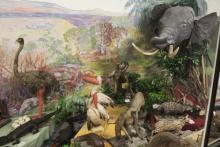
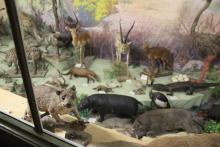
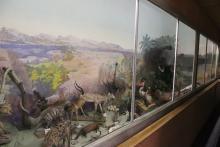
This is a relatively small museum in the heart of a working monastery 40 km west of Munich. It houses zoological and ethnological artifacts brought back by the brothers from their missionaries in Africa and Asia. What is special about this museum is that it has changed little since its conception in 1911.  The way the objects are displayed, the cabinets (made by the monks) the taxonomy and even the amateur taxidermy preformed by the monks has a very unique character.  When I was there in spring 2013 they were in the middle of a renovation; new wheelchair access, lighting, climate control as well as improved security. They also want a ‘more extensive commentary’ that I sincerely hope they do no over do. They do seem to understand the uniqueness of what they have and state that ‘the great challenge is to achieve this without loosing the charm and character of our “old museum”.


Natural History Museum, Berlin

Easter 2014 I revisited the Natural History Museum in Berlin and it is clear that they are continuing to ‘re-shape the concept of a modern research museum’.  Their website actually states that this work will focus on the ‘sympathetic restoration and modernisation of collection rooms’ and from what I could see this is well underway. They also have a ‘master plan’ that includes comprehensive renovation of existing parts of the building, extensions and a new building.   I intend to keep an eye on this development and hopefully they will maintain their high level of sympathetic restoration and remain an example of good practice.

Berlin Museum

ME Collectors Room, Berlin

The ME Collectors Room in Berlin (May 2014), next door to the KW Institute for Contemporary Art, houses the marvelous Wunderkammer Olbricht.

Thomas Olbricht, (b. 1948), has put together one of the most extensive private collections in Europe, encompassing works from the early 16th century to the most recent contemporary art. The gallery is half a contemporary art gallery (downstairs) and half wonder cabinet (upstairs).

This Kunstkammer is a shadow of one originally assembled in Berlin by Elector Joachim II (1535 – 1571), rebuilt by Elector Friedrich Wilhelm and eventually housed in the City Palace by Friedrich III, but like so many it did not survive the Enlightenment.  Any remaining objects were dispersed to the new museums.

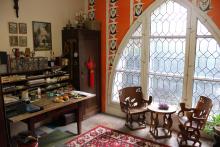
This private collection reanimates the idea of the wonder cabinet in Berlin and fulfills the ‘original intention of some two to five centuries ago: to transport the visitor into a realm of sheer astonishment’.  The cabinet houses a rich assemblage of antique objects, including the essential stuffed crocodile in the celling and mermaid, however it is invigorated by intermittent contemporary artworks.  These have been carefully chosen to sit comfortably with the other objects, with the effect of extending and reinvigorating the collection.