The Workhouse, Southwell
unich’s Museum of Hunting and Fishing (Deutsches Jagd und Fischereimuseum)
I’m here in Munich on a three-week artist in residence 8-28th July 2015 and my fist stop is the German Hunting and Fishing Museum. As a lover of taxidermy I knew I had to visit and I was not disappointed with the immaculate panoramas featuring native species such as wild bore, dear and foxes. However, I was also very pleasantly surprised to come across a whole set of beautiful, small scale panoramas of hunting scenes through the ages featuring tiny flat painted tin figures. I am very fond of scale models and these painted scenes presented within glass-fronted boxes set into the walls of the ornate staircase were a treat.
Musei de Palazzo Poggi, Bologna, Itally
I first visited the Musei de Palazzo Poggi way back in 2012 when I was setting up Creating a Context , an International, project for Postgraduate students in Art and Architecture involving seven Universities across Europe, funded by the British Council. It was love at first site. I have since returned several times. Myself and several colleagues from Newcastle University are currently working on extending the project A Scientific Encounter to work with the University of Bologna and the Palazzo Poggi. It has a wonderful collection beginning with a cabinet of curiosities based around the work of Ulisse Aldrovandi (1522-1605) and the wood cuts made to illustrate his volumes on ‘natural things’. This flows into a medical section featuring obstetrics and a unique collection of full size ceramic models of fetus in different positions in the uterus. There is also a small collection of scientific instruments focused on light, optics and electrical physics, and a wonderful collection of large scale model ships, maps and globes. Every time I visit it is never for less than half a day.
The Viktor Wynd Museum of Curiosities, Fine Art & Natural History, London.
Museum of Pharmacy, Krakow
Grand Musee Spitzner
At the end of the tour of the Museum of Anatomy in the Faculty of Medicine in Montpellier we were taken to a separate room to see a new exhibition recently relocated from the Faculty of Medicine in Paris. It contained anatomical models that were once part of Pierre Spitzner’s traveling museum, the “Grand Musee Spitzner”, a famous set of anatomical wax models dating from the 19th Century.
This collection of models, casts, specimens, paintings, dioramas, etc. toured Europe for about a century before being dismantled around 1913. Some of the Spitzner pieces ended up at the University of Paris, but unfortunately many others have been lost. Spitzner’s centrepiece, a wax anatomical model of a sleeping woman, which opens to reveal her internal organs has survived however, as has several other striking obstetrical Venuses with strange disembodied male hands holding them down and preforming proceedures. Also a sleeping beauty whose chest would rise and fall as she seemed deep asleep, posing provocatively in her nightgown upon an uncomfortable looking rock.
The collection is of particular interest to my resent research and has a direct correlation to my Gallery of Wonder on Tour project, a mobile exhibition of extraordinary works of art, touring the agricultural fairs and border shepherd shows of Northumberland, UK, in a large black tent during summer 2015. This project has its roots in the history that links cabinets of curiosity, traveling fairground exhibitions, public museums and science, therefor the touring museum of ‘le docteur Pierre Spitzner’ is of particular relevance to my continuing research.
Link to a very interesting essay Venus and the Archive –Waxworks of the Pregnant Body by Elizabeth Stephens
Thackray Medical Museum, Leeds, UK
Museum of Anatomy of the Faculty of Medicine in Montpellier (France)
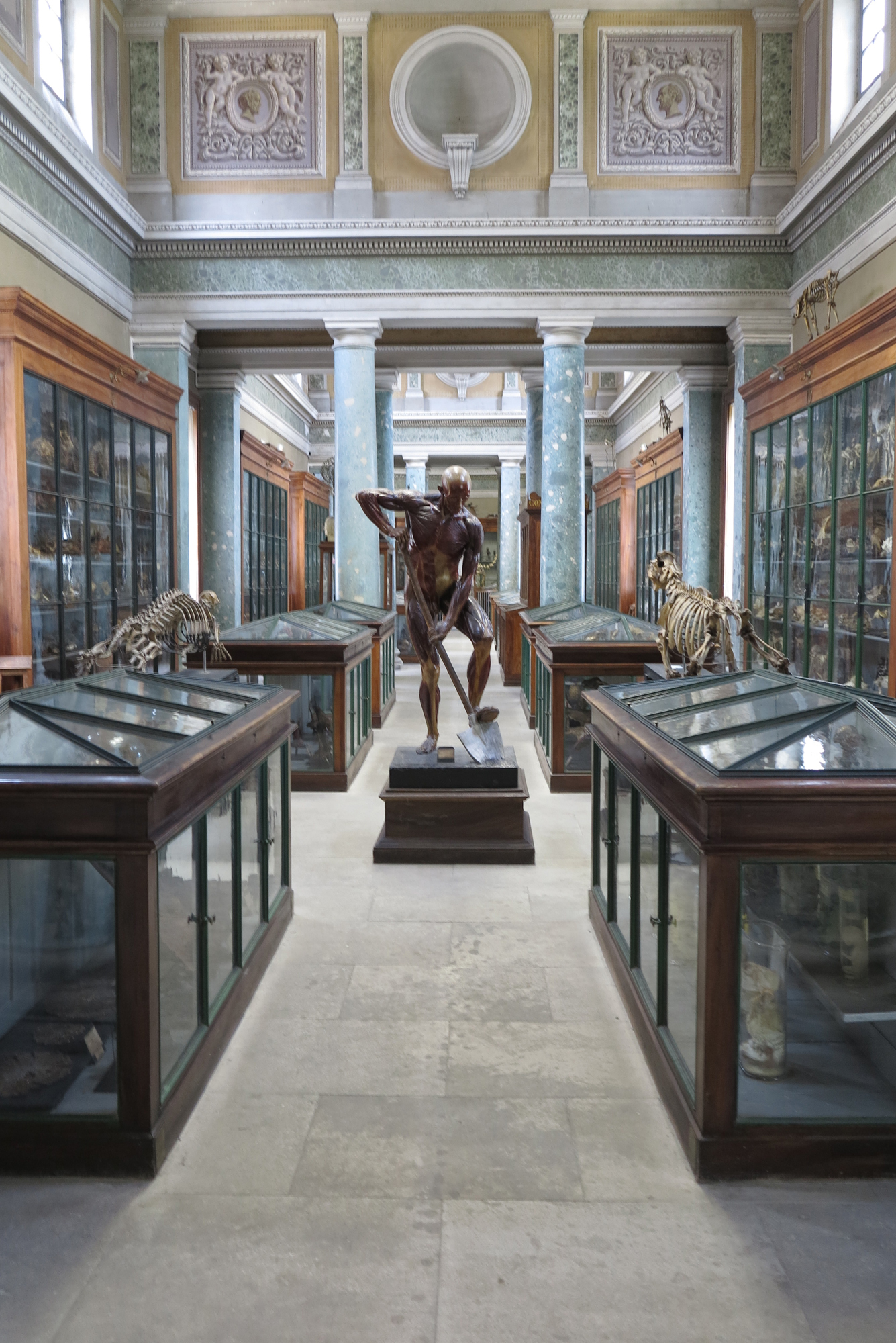
I have recently returned from a whistle stop tour of the museums and collections held by the University of Montpelier with a view to developing an exhibition in the Faculty of Medicine in 2016, responding to their incredible collection. The Faculty of Medicine has been operating since 1181 and their Museum of Anatomy is a rare and magnificent wonder. One vast 60 meter long strikingly decorated gallery houses one of the largest and oldest anatomy collections in the world. The collection is exceptionally authentic and seems unchanged since its original construction in 1851. Hand written, labels in copperplate French and Latin describe the meticulous wax models of disease and deformity and carefully prepared human and animal specimens. The collection was cleaned and some repairs to the leaking roof made in 2004 but this was obviously carried out with a light touch, respecting not only the objects but also the heritage of the museum itself. No doubt one or two of the anthropological and anatomical displays are problematic to contemporary eyes but it is, I believe important to have some record, some understanding of the development of both our scientific, ethical and moral progress.
We also visited the enigmatic Jardins des Plantes de l’Université Herbarium founded in 1593 with over 4,000,000 specimens. A vast catacomb of 1600-square-metres of dark shelf-lined corridors containing bulging portfolios of carefully pressed, preserved and catalogued plants and fungi and ancient herbal texts. We were also allowed access to the eclectic scientific collections temporarily housed in the attics and basement, awaiting a permanent home.


Biography
I am a sculptor and site–specific installationist. My research and practice is engaged with wonder, focusing on the history and philosophy of science, specifically cabinets of curiosity (wonder cabinets), investigating the threshold between aesthetic and scientific realms. I work directly in response to place, usually a museum or heritage site, using a broad range of media including sculpture, video, virtual reality and augmented reality.
I have supervised five PhD’s to successful completion and am currently supervisor for five PhD students across a range of topics related to installation, ecology and history.
Research Interests
In 2010 I established the Gallery of Wonder as a discussion point and exhibition facility for research into the evocation of wonder through visual display. Building upon research outcomes of the GoW project, I continue to explore the potential of art to reinterpret and represent historical information in a manner that engages and stimulates ‘wonder’ in the viewer, producing new artworks for specific sites of historical and scientific interest. These temporary site-specific installations provide alternative approaches to conventional methods of informational display, stimulating debate and encouraging museums and heritage sites to explore the potential of art to attract and expand their audiences.
‘Brown explores the curiosity, wonder and even terror that accompanied scientific experiments from the seventeenth- to the nineteenth centuries. In her work, we see that the Enlightenment commitment to objective and universal truths, and to uncovering nature’s ‘secrets’, were only ever partial, and accompanied by darker impulses. Those things invisible to us – the microscopic life and the stars beyond our sight, and the electricity that is invisible, inaudible, and untouchable – are not ‘objects of knowledge’ we can safely command. They are both Other to us, and able to exert forms of power over us, rather than vice versa’. (A. Robinson NGA)